A 1–1 draw between Spain and Cape Verde in a World Cup 2026 setting would be widely described as a shock result because it flips the usual expectations attached to these two football nations. Spain are traditionally viewed as an elite contender with tournament-winning pedigree, while Cape Verde are often categorized as a dangerous underdog still building a consistent global track record.
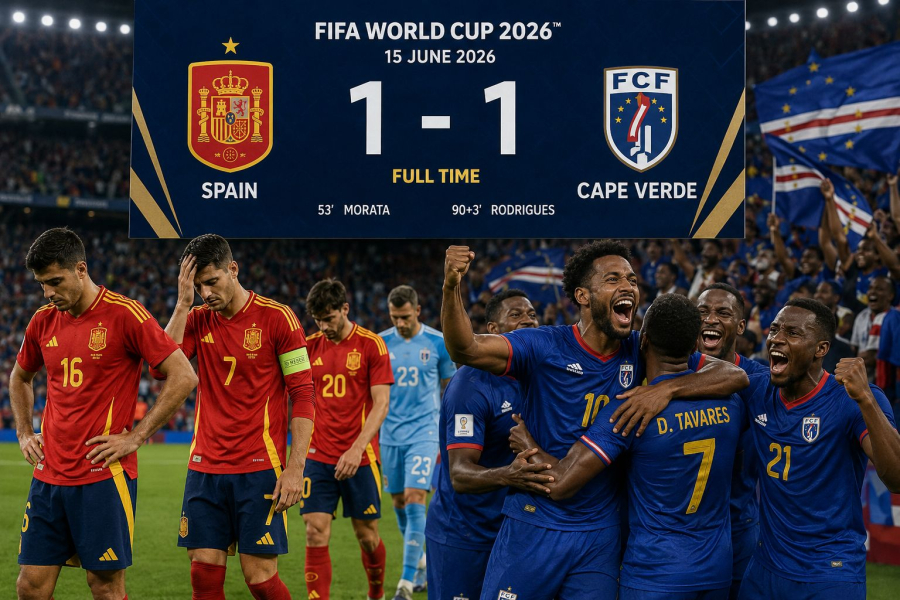
Even without assuming any specific match details, a draw like this would stand out because it challenges the common assumptions fans, analysts, and markets tend to make about probability, styles, and depth at the World Cup level. It would also be a powerful reminder of what makes international football so compelling: in a single game, execution, momentum, and belief can narrow gaps that look huge on paper.
1) Spain’s pedigree sets a high baseline expectation
Spain enter most major tournaments with the reputation of a team that should control matches, progress deep, and avoid “slip-ups” in the group stage. That expectation comes from decades of:
- Proven tournament success at the highest level (including a World Cup title and multiple European championships).
- Consistent production of elite players competing in top domestic and European competitions.
- A well-defined football identity centered on technical quality, structured possession, and positional play.
Because Spain are typically projected as favorites in matchups against nations outside the traditional global elite, a 1–1 scoreline would read as Spain “dropping points,” even if the performance itself had positives.
2) The perceived gap in depth and resources amplifies the surprise
“Shock result” narratives often grow from the idea of unequal resources: player pools, league infrastructure, and competitive exposure. Spain’s player selection is usually deep enough to field multiple lineups with international-level quality. Cape Verde, while increasingly competitive, are generally expected to have:
- A smaller player pool relative to established football giants.
- Less historical experience in the late stages of World Cup tournaments.
- More reliance on clear tactical organization and moments of efficiency.
This doesn’t make Cape Verde “weak.” It makes their pathway different. And when a team with a smaller margin for error earns a draw against a favorite, it naturally reads as an outsized achievement.
3) World Cup matches punish missed chances and reward efficiency
International tournaments are uniquely unforgiving. Teams have limited time together, and game states swing quickly. A 1–1 draw can happen even when one side dominates the ball, because World Cup football often rewards:
- Finishing quality over chance volume.
- Set-piece execution (corners, free kicks, throw-ins) as a reliable scoring channel.
- Defensive concentration for long stretches.
- Transition speed when the opponent commits players forward.
Spain are often expected to create and convert enough chances to separate from underdogs. If the match ends 1–1, it signals that Cape Verde matched Spain’s efficiency and resisted long enough to keep the game within one moment.
4) Cape Verde’s upside: organization, athleticism, and game management
One reason a 1–1 draw would feel shocking is that it also signals something uplifting: Cape Verde’s football growth translating onto a global stage. Underdogs don’t “accidentally” draw elite teams in World Cup environments. It typically takes multiple strengths working together, such as:
- Compact defensive spacing that closes central passing lanes.
- Disciplined pressing triggers rather than constant chasing.
- Smart fouling and stoppage control to break rhythm at key moments.
- Physical and mental resilience after conceding or under pressure.
From a benefit standpoint, a performance capable of securing a draw against Spain would immediately elevate the perception of Cape Verde as a team that can compete with any opponent when they execute their plan.
5) Spain’s style can invite underdog game plans if the tempo drops
Spain’s possession-oriented identity is a massive strength, but it can also create an opening for an underdog to stay alive if Spain don’t turn control into end product. A draw becomes more plausible when:
- Possession is slow and predictable, allowing a low block to shift comfortably.
- Attacks become wide-cross heavy without enough runners in the box.
- Shots come from lower-value areas rather than cutbacks and central combinations.
- The opponent is happy to defend for long spells and wait for one or two decisive breaks.
In other words, Spain can look dominant while the score remains close. When that happens, one well-executed transition or set piece can turn a “comfortable” game into a headline-making 1–1.
6) The psychology of the group stage makes draws feel bigger
At the World Cup, every point matters. A draw isn’t just a draw; it reshapes the group’s math and the emotional landscape. A 1–1 between Spain and Cape Verde would feel shocking because it would:
- Improve Cape Verde’s qualification chances by proving they can take points off top opposition.
- Add pressure on Spain to deliver in subsequent games, where opponents may now believe Spain can be held.
- Create a new group narrative where underdogs are no longer simply “participants,” but contenders.
This is part of why World Cup upsets and near-upsets have such lasting impact: they change belief, not just standings.
7) Tournament football magnifies single-game variance
Over a long league season, quality tends to rise to the top. Over 90 minutes, variance becomes a feature, not a bug. A 1–1 draw would be considered a shock because it is precisely the kind of result that can happen when:
- A favorite has a slightly off day in sharpness, decision-making, or finishing.
- An underdog has a peak day in concentration, energy, and execution.
- Key moments (a save, a clearance, a set piece) land the underdog’s way.
None of these require anything “miraculous.” They are normal elements of football. The shock comes from how rarely they line up perfectly against a powerhouse like Spain.
8) Why it would be a positive story for Cape Verde (beyond the headline)
From a benefit-driven perspective, a 1–1 draw against Spain would be a milestone with real competitive advantages for Cape Verde:
- Belief and identity: It validates the team’s approach and builds internal confidence.
- Momentum: A point against a favorite can unlock braver performances in the next games.
- Global respect: It signals that preparation, structure, and talent development are paying off.
- Future opportunities: Strong tournament performances often accelerate player recognition and program investment.
Even if the tournament continued with mixed results, that single match would serve as proof that Cape Verde can compete with elite opposition when they stick to a clear plan.
9) Why it can still be a constructive moment for Spain
While “shock result” framing often centers on the favorite’s disappointment, a 1–1 draw can still produce valuable upside for Spain in a tournament:
- Early calibration: It highlights what needs sharpening before knockout rounds.
- Tactical clarity: It tests solutions against a compact defense and counter threat.
- Squad learning: It reveals which combinations create the most threat under pressure.
- Motivation: It can sharpen focus and urgency in the matches that follow.
In many successful tournament runs, top teams have a wake-up call early on. The key is turning that moment into better execution rather than panic.
Quick comparison: why the “shock” label appears so quickly
| Factor | Typical expectation for Spain | Typical expectation for Cape Verde | Why 1–1 feels surprising |
|---|---|---|---|
| Global pedigree | Established contender | Emerging competitor | A draw challenges the assumed hierarchy |
| Squad depth | Multiple high-level options | Narrower margins | Underdogs are expected to fade late, but a draw suggests staying power |
| Game control | High possession and territory | More selective possession | Control without separation can be punished in one moment |
| Scoring pathways | Combination play, sustained pressure | Transitions, set pieces, efficiency | Low-volume chances can still produce a result in tournament football |
What a 1–1 would ultimately say about World Cup 2026
A Spain vs Cape Verde 1–1 draw would be labeled a shock because it collides with long-held expectations about elite teams “handling” underdogs. But the most compelling takeaway would be positive: it would showcase how far so-called smaller nations can climb with structure, fitness, and belief, and how the World Cup consistently rewards teams that execute under pressure.
In a single match, football doesn’t always crown the strongest resume. It rewards the best performance on the day. That is exactly why a 1–1 between Spain and Cape Verde would capture attention worldwide.
Note on accuracy: This article explains why such a scoreline would be considered shocking in a World Cup context based on widely understood football dynamics (pedigree, depth, styles, and tournament variance), rather than asserting details of a specific played match.
