Spain head into the 2026 FIFA World Cup cycle with something rare: a proven winning base and a wave of fearless young talent that already thrives on the biggest stages. After lifting the UEFA Nations League in 2023 and winning UEFA Euro 2024 with a perfect seven wins from seven matches, La Roja aren’t rebuilding from scratch. They’re evolving a squad identity that blends technical control with sharper, more direct attacking punch.
This guide introduces the core group powering Spain’s momentum, the difference-makers who decide tournament games, and the next-in-line prospects who could force their way into the 2026 picture. Because the final World Cup roster cannot be known in advance, this article stays factual and focuses on players who have already been central to Spain’s recent success or have clearly emerged as major options in the current cycle.
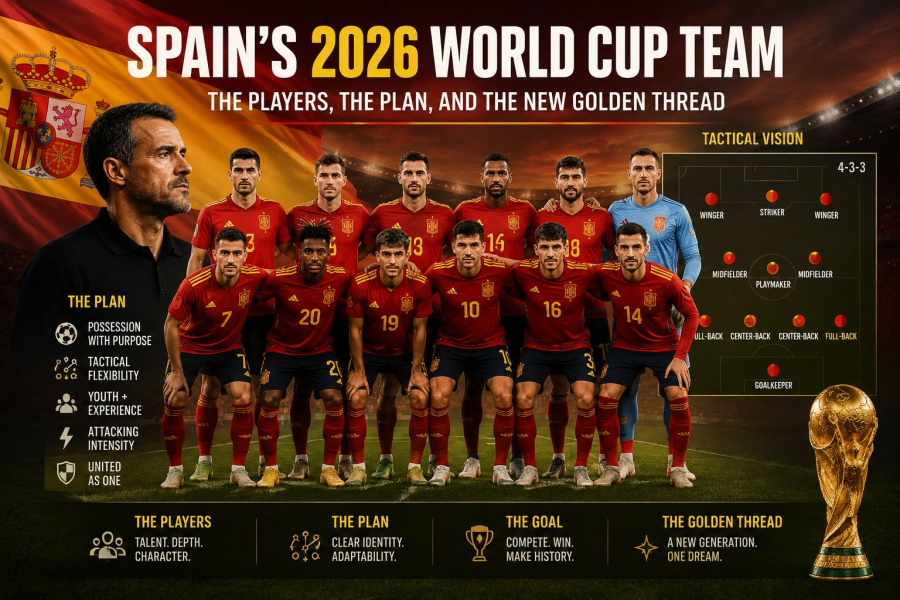
The leadership: coach, culture, and what Spain want to be in 2026
Luis de la Fuente and the “win-now, develop-always” approach
Spain’s modern identity has long been linked with possession and technical excellence. Under head coach Luis de la Fuente, Spain have kept that tradition while adding a more tournament-pragmatic edge: quicker transitions, wide threat, and a willingness to attack space earlier in moves rather than waiting for perfect patterns.
The biggest proof point is Euro 2024, where Spain played with both control and vertical intent, scoring freely while remaining structurally disciplined.
The benefits of Spain’s current squad build
- Elite midfield control that can slow games down or speed them up.
- Wide 1v1 quality that forces defensive dilemmas and creates high-value chances.
- Tournament experience across multiple positions, including players who have already won major finals.
- Young upside without sacrificing reliability, which matters across a long World Cup month.
Spain’s likely 2026 spine: the core that makes everything work
World Cup winners usually have a “spine” you can trust under pressure: goalkeeper, central defenders, central midfield anchor, and a reliable source of goals or chance creation. Spain’s current cycle has several pillars who have already delivered in knockout football.
Unai Simón (born 1997) — goalkeeper calm under heat
Unai Simón has been a steady presence at the back for Spain in recent tournament runs. His value is not only shot-stopping, but decision-making: when to claim, when to hold position, and when to use distribution to restart attacks cleanly.
Anecdote angle: Spain’s build-up structure often puts the goalkeeper under the spotlight. Simón’s composure helps Spain keep their identity even when opponents press aggressively.
Rodri (born 1996) — the midfield anchor who sets the tournament tone
If you want a single name that explains Spain’s balance of safety and ambition, it’s Rodri. He gives Spain a platform: protecting the defense, reading counterattacks early, and keeping possession purposeful rather than passive.
At Euro 2024, Rodri was recognized as Player of the Tournament, a reflection of how influential he was in Spain’s title run. For a World Cup, that kind of control is a competitive advantage because it reduces chaos over seven demanding matches.
Aymeric Laporte (born 1994) — experience and composure in the center
In tournament football, the best teams don’t just defend well; they defend calmly. Laporte brings a composed presence in central defense and helps Spain stay connected from back to front, especially when opponents try to force long clearances or rushed decisions.
Álvaro Morata (born 1992) — leadership, movement, and a reference point up top
Morata’s value is bigger than one statistic. As a senior forward and leader in the group, he provides a constant reference for Spain’s attacks: running channels, occupying center-backs, and creating space for wide attackers and late-arriving midfielders.
In a World Cup cycle, that blend of experience and functional role clarity can be decisive, particularly when matches tighten and the margins shrink.
The headline-makers: Spain’s game-changers for 2026
Spain’s recent success has been powered by players who can win duels, create separation, and produce moments that break tactical stalemates. These are the names that make opponents change their plan.
Lamine Yamal (born 2007) — a record-breaking winger with fearless creativity
Lamine Yamal has already delivered historic milestones on the European stage. At Euro 2024, he became the youngest player to appear in the tournament and later the youngest goalscorer in European Championship history with his strike against France.
What makes him special for 2026 is not only the headline records. It’s the repeatable skill set: close control at speed, comfort in tight spaces, and the confidence to attempt high-difficulty actions when defenses are set.
Why it matters at a World Cup: When knockout games get cagey, a winger who can create something from “nothing” is a luxury that often becomes a necessity.
Nico Williams (born 2002) — pace, directness, and big-game output
Nico Williams brings a direct threat that complements Spain’s possession game. He attacks the full-back, drives into the box, and forces defenses to retreat. At Euro 2024, he scored in the final as Spain went on to lift the trophy, delivering on the biggest stage.
For 2026, his biggest benefit is tactical: when Spain circulate the ball and draw opponents in, Nico can punish the space that appears behind the press.
Dani Olmo (born 1998) — movement between the lines and tournament timing
Olmo’s game is built for tournament football: he finds space between midfield and defense, arrives at the right time in the box, and can unlock compact blocks. At Euro 2024, he finished among the tournament’s top scorers with three goals, highlighting his knack for decisive contributions.
Pedri (born 2002) — rhythm, intelligence, and control in possession
Pedri represents the best of Spain’s midfield tradition: he plays with tempo awareness, scanning, and the ability to progress the ball without forcing it. When Pedri is available and at full sharpness, Spain’s passing game becomes more fluid and harder to press.
Fabián Ruiz (born 1996) — left-foot quality and midfield balance
Fabián adds variety: he can carry the ball forward, switch play to change the point of attack, and contribute with late runs. In tournaments, that extra layer of midfield threat helps prevent opponents from focusing only on wingers and strikers.
The supporting cast: the “glue” players who raise Spain’s floor
Championship squads are not only about stars. They’re about players who make the system stable across different opponents and match states.
Robin Le Normand (born 1996) — structure and reliability
Le Normand has been an important part of Spain’s defensive options, offering aerial competitiveness, positioning, and a consistent approach. These traits matter across a World Cup group stage, where styles vary and adaptability is everything.
Dani Carvajal (born 1992) — experience, intensity, and timing
Carvajal brings high-level experience in high-stakes matches. Full-back is a role that swings games in modern international football, and Spain benefit from a defender who can defend wide transitions while also contributing to overlaps and combinations.
Mikel Oyarzabal (born 1997) — clutch instincts
Oyarzabal has shown the kind of end-product that decides finals. He scored the winning goal in the Euro 2024 final, a defining moment that underlines his composure and timing in the box.
For 2026, that “clutch factor” is a real asset: it’s the difference between a good tournament and a title run.
The next wave: rising names who could shape the 2026 roster battle
Spain’s advantage is that they do not only have a strong first-choice group; they also have competition. That competition drives standards and gives the coaching staff options when form, injuries, or matchups demand changes.
Gavi (born 2004) — intensity and edge in midfield
Gavi has already proven he can perform at the top level, bringing aggression, ball-winning, and momentum-shifting energy. When fit and in rhythm, he adds bite and personality to Spain’s midfield rotations.
Alejandro Balde (born 2003) — speed and width from full-back
Balde offers a modern full-back profile: acceleration, recovery pace, and the ability to create width high up the pitch. In games where Spain want to stretch the opponent and overload wide areas, this profile can be especially valuable.
Pau Cubarsí (born 2007) — composure beyond his years
One of the standout storylines in Spain’s talent pipeline is the emergence of very young defenders who are comfortable in possession. Cubarsí has drawn attention for his calm distribution and decision-making, qualities that align naturally with Spain’s playing model.
Whether 2026 comes too early or arrives right on time for him will depend on match experience and the competitive depth at center-back, but the trajectory is clearly one to watch.
At-a-glance table: key Spain players for the 2026 cycle
| Player | Born | Role | Notable factual highlight | Why it’s a 2026 advantage |
|---|---|---|---|---|
| Unai Simón | 1997 | Goalkeeper | Established Spain starter in major tournaments | Stability and calm distribution under pressure |
| Rodri | 1996 | Defensive midfielder | UEFA Euro 2024 Player of the Tournament | Controls tempo and protects against transitions |
| Aymeric Laporte | 1994 | Center-back | Key part of Spain’s recent defensive core | Composure in knockout match moments |
| Dani Carvajal | 1992 | Right-back | Veteran of elite-level finals | Experience plus tactical discipline wide |
| Pedri | 2002 | Midfielder | Established international playmaker profile | Improves ball progression and press resistance |
| Dani Olmo | 1998 | Attacking midfielder | Three goals at Euro 2024 (among top scorers) | Between-the-lines threat in tight games |
| Nico Williams | 2002 | Winger | Scored in the Euro 2024 final | Direct running that stretches compact defenses |
| Lamine Yamal | 2007 | Winger | Youngest Euro player and youngest Euro goalscorer (Euro 2024) | Unpredictable creativity that breaks stalemates |
| Mikel Oyarzabal | 1997 | Forward | Scored the winning goal in the Euro 2024 final | Proven end-product under maximum pressure |
| Álvaro Morata | 1992 | Striker | Senior leader in the forward line | Experience, movement, and reference-point play |
What makes Spain especially dangerous in 2026
1) They can win multiple ways
Spain are no longer a one-gear team. They can dominate the ball, but they also have the pace and 1v1 strength to hurt opponents quickly. That flexibility matters because World Cup opponents vary dramatically in style, from low blocks to high presses.
2) Their wide threats change the math
When wingers like Nico Williams and Lamine Yamal win duels, opponents are forced to send extra help. That opens passing lanes for midfielders like Pedri and finishers arriving late, and it reduces the “perfect pass required” problem that possession teams sometimes face.
3) Their midfield can protect leads
In knockout rounds, protecting a 1–0 lead is a skill. With an anchor like Rodri and technicians around him, Spain can manage rhythm, reduce turnovers, and turn defending into controlled possession phases.
Storylines to watch as the 2026 squad takes shape
- How the young stars mature: The leap from prodigy to consistent tournament performer is the difference between excitement and dominance.
- Full-back balance: Spain’s ability to defend transitions while still creating width can determine how far they go.
- Goal sources beyond the striker: Tournament winners often get key goals from wingers and midfielders, and Spain’s recent big-game scorers suggest they have that variety.
- Center-back combinations: Chemistry in the heart of defense is built over time, and Spain’s depth will keep selection competitive.
FAQ: Spain and the 2026 World Cup
Is Spain’s 2026 World Cup squad already confirmed?
No. World Cup squads are finalized much closer to the tournament. This article highlights players who have already been important for Spain in recent tournaments and are strong contenders to shape the 2026 cycle.
What recent titles show Spain are ready to compete for 2026?
Spain won the UEFA Nations League in 2023 and UEFA Euro 2024. At Euro 2024, Spain won all seven of their matches, a standout indicator of consistency across the full tournament.
Who are Spain’s most exciting attacking talents right now?
Lamine Yamal and Nico Williams have already delivered decisive Euro 2024 moments, while players like Dani Olmo and Mikel Oyarzabal provide proven end-product in high-pressure games.
Bottom line: Spain look built for a deep 2026 run
Spain’s strongest 2026 advantage is the blend of tournament-winning experience and high-ceiling youth. With a midfield capable of controlling games, wide players who can win duels, and multiple attackers who have already scored in decisive moments, La Roja have the profile of a genuine contender.
As qualification and pre-tournament camps shape the final choices, the headline remains the same: Spain are not simply aiming to play well in 2026. They are building to win.
