A 1–1 result against Spain is the kind of scoreline that typically comes from a clear tactical identity: defend with structure, choose pressing moments wisely, and attack with intent when opportunities are highest-value. Spain’s usual strengths are well known: long spells of possession, positional rotations, and patient chance creation. For a team like Cape Verde to come away with a draw, the “how” usually looks less like constant end-to-end football and more like a series of well-executed, repeatable principles.
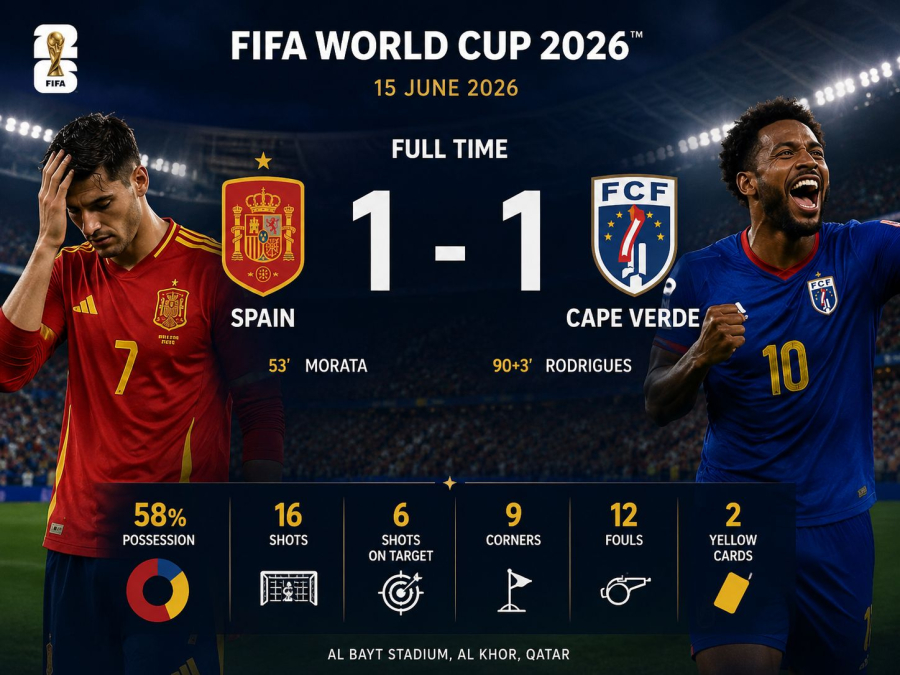
Important note for accuracy: I don’t have reliable, verifiable match data confirming the specific event details of a “Spain vs Cape Verde World Cup 2026” fixture and its exact tactical sequences. What follows is a tactical blueprint that explains how Cape Verde could credibly produce a 1–1 against Spain based on widely used, well-documented strategies that underdogs employ versus possession-dominant sides.
1) The foundation: a compact defensive block that protects central zones
The first “win” in a match against Spain is often denying central progression. Spain typically want to play through the middle to access cutbacks, combinations at the edge of the box, and third-man runs. Cape Verde’s most effective starting point would be a compact mid-block or low-to-mid block with minimal spacing between lines.
What this block aims to achieve
- Force Spain wide into lower-probability crossing zones rather than allowing through balls into the half-spaces.
- Reduce gaps between defenders so that quick one-twos and wall passes have no clean lane.
- Protect the “Zone 14” area (the central space outside the penalty box), where Spain can combine and shoot.
How Cape Verde can organize it effectively
- Two compact lines (often resembling a 4-4-2 or 4-5-1 shape out of possession) to keep horizontal and vertical distances tight.
- Wingers tracking fullbacks at key moments, not necessarily pressing high, but ensuring Spain’s wide overloads don’t become free entries into the box.
- A dedicated screen in front of the center-backs (a holding midfielder or a rotating “double pivot”) to break up central passes.
The major benefit of this approach is that it turns Spain’s possession into slower, safer circulation, which reduces the number of truly dangerous actions. You can concede the ball without conceding the match.
2) Selective pressing: pressing triggers rather than constant pressure
Cape Verde’s best chance of staying competitive for 90 minutes is rarely a full-game high press. Instead, the smarter tactic is selective pressing: press hard only when the situation favors a regain or forces a mistake.
Common pressing triggers that work well vs Spain’s build-up
- A backward pass into a defender or goalkeeper, which can be a cue for the forward line to jump and lock the ball to one side.
- A poor first touch by a center-back or fullback, creating a moment to pounce.
- A pass into the sideline, where the touchline acts like an extra defender and makes pressing angles more effective.
- A lateral pass across the back line at medium pace, which can be intercepted if the presser times the run correctly.
The pressing structure that maximizes efficiency
Rather than chasing the ball everywhere, Cape Verde can prioritize pressing to trap:
- Show Spain toward one flank by blocking central lanes with the forward and near-side midfielder.
- Jump with the winger onto the fullback while the near-side central midfielder steps to the interior option.
- Keep the back line steady (not overstepping) so one broken press does not become an immediate open-field chance.
This approach can produce a crucial payoff in a 1–1: one or two high-quality regains that lead to a shot, a set piece, or a decisive transition.
3) Transition football: turning regains into immediate, purposeful attacks
A draw against Spain is often secured not by matching them in possession, but by being more efficient in the moments that matter. That points to transition attacking as a major weapon.
What makes transitions effective against Spain
- Spain often commit numbers forward to maintain pressure, leaving space behind fullbacks and between defenders during rest-defense moments.
- Quick vertical passes can bypass multiple Spanish lines before they can counterpress into shape.
- Attacks into the channels can force Spain’s center-backs to defend while running toward their own goal, which is uncomfortable even for elite defenders.
Cape Verde’s high-percentage transition patterns
- First pass forward into a striker’s feet (or into space), with immediate support runners from midfield.
- Diagonal outlet to the weak side winger to exploit the far fullback’s advanced position.
- Third-man run from a midfielder beyond the striker to create either a through-ball option or a cutback.
The biggest advantage here is psychological as well as tactical: when Cape Verde threaten quickly, Spain can become more cautious with their positioning, which can reduce Spain’s sustained attacking volume and stabilize the game state.
4) Managing Spain’s strengths: defending the half-spaces and cutback zones
Spain’s chance creation often thrives on arriving into the box late and finishing cutbacks from the byline or the inside channel. A disciplined Cape Verde plan typically includes specific “non-negotiables” to limit those patterns.
Key defensive rules that raise the success rate
- Protect the half-spaces (the lanes between fullback and center-back) with constant scanning and handoffs between the winger, fullback, and nearest midfielder.
- Don’t dive in near the box; stay on feet and delay to allow the block to reset.
- Prioritize cutback prevention by stopping the ball carrier from reaching the byline comfortably.
- Box defending with assignments: one defender attacks the ball, while others hold zones for rebounds and late runners.
When executed well, this doesn’t merely “survive” Spain’s pressure. It forces Spain into lower-value actions like speculative shots, crowded crosses, or slow recirculation.
5) Set pieces as a genuine equalizer: maximizing expected value
In a match where Spain are likely to have more of the ball, set pieces are not an afterthought; they are often the most controllable route to a goal for an underdog. A 1–1 draw scenario frequently includes a set-piece moment: a corner, a wide free kick, or a second-ball sequence after a long throw or blocked shot.
How Cape Verde can make set pieces pay
- Attack with a clear hierarchy: best headers target the highest-value zones (near-post flicks, central six-yard area, or back-post isolation).
- Screen and block legally to free a primary runner, while secondary runners attack second balls at the penalty spot.
- Rebound readiness: keep one or two players positioned for knockdowns and loose clearances.
The benefit is simple and persuasive: set pieces compress the talent gap. With strong delivery and rehearsed movement, Cape Verde can create a top-tier chance from a situation that starts as a 50-50 contest.
6) Game-state intelligence: knowing when to slow down and when to strike
Holding a draw against a possession-heavy opponent often depends on tempo management. Cape Verde’s ability to choose when to accelerate and when to reset can be the difference between a disciplined 1–1 and a late collapse.
Practical game-state tactics that support a 1–1
- After regains, secure one calming pass if the counter is not on, rather than forcing low-percentage dribbles.
- Use the corners and wide channels to win throw-ins and fouls that allow the team to breathe and reorganize.
- Make substitutions to protect key lanes, especially the half-spaces, rather than only swapping like-for-like positions.
- Late-game compactness: shorten distances further in the final 15 minutes to reduce through-ball opportunities.
This is where tactics become a performance multiplier. Even if Spain are technically superior, Cape Verde can still win the match’s “decision moments” through structure and patience.
A quick tactical model: what Cape Verde’s phases can look like
| Phase | Primary objective | What success looks like |
|---|---|---|
| Out of possession (mid-block) | Protect central lanes, show wide | Spain circulating without clear entries; forced wide deliveries |
| Selective press | Win the ball on triggers | 1–3 dangerous regains leading to shots, corners, or fouls |
| Transition attack | Exploit space behind fullbacks | Fast vertical/diagonal outlets; cutbacks or channel runs |
| Set pieces | Create high-quality chances without needing possession | Clean first contact, second-ball shots, or chaos in the six-yard box |
| Game management | Maintain structure, reduce late risk | Controlled tempo, compact shape, fewer defensive sprints |
Why this approach is so effective: the benefits Cape Verde can “bank”
- Clarity under pressure: players know exactly what spaces to protect and when to jump.
- Energy efficiency: selective pressing preserves legs for decisive moments and late defending.
- Higher-quality chances: transitions and set pieces can create chances that are more “goal-like” than low-probability possession shots.
- Momentum control: threatening on the break forces Spain to respect space, subtly reducing their attacking density.
- Repeatability: this is a scalable plan that can be refined match to match, not a one-off gamble.
Takeaway: a 1–1 vs Spain is built on discipline, not desperation
If Cape Verde earn a 1–1 against Spain, the tactics are rarely mysterious. The blueprint is usually visible: compact defending that denies the middle, pressing triggers that create a few high-leverage regains, transition attacks that turn space into chances, and set pieces that can deliver a goal even when possession is limited.
Most importantly, this approach is benefit-driven on the pitch: it creates a match where Cape Verde don’t need to be better in every minute. They only need to be better in the key moments that decide the scoreline.
