If you’re backing Spain and looking for a clear, persuasive case for why Spain should beat Cape Verde in a World Cup setting, the good news is that the argument can be made on solid, factual foundations: Spain’s tournament pedigree, tactical structure, and ability to manage high-pressure moments tend to travel well to any “must-win” stage.
At the same time, it’s worth keeping the framing accurate. A “World Cup” can refer to different sports (football/soccer, basketball, and others). Rather than claiming a specific fixture, date, or official matchup, this article focuses on what typically decides a World Cup game and why those factors generally tilt in Spain’s favor against a smaller, emerging program like Cape Verde.
The core reason: Spain’s advantages are built for tournament football (or tournament basketball)
World Cup games rarely reward only raw talent. They reward repeatable performance: clear systems, depth, composure, and the ability to adapt mid-game when the plan meets resistance. Spain is historically strong in these areas across major international competition, which is why they are often viewed as favorites against less established nations.
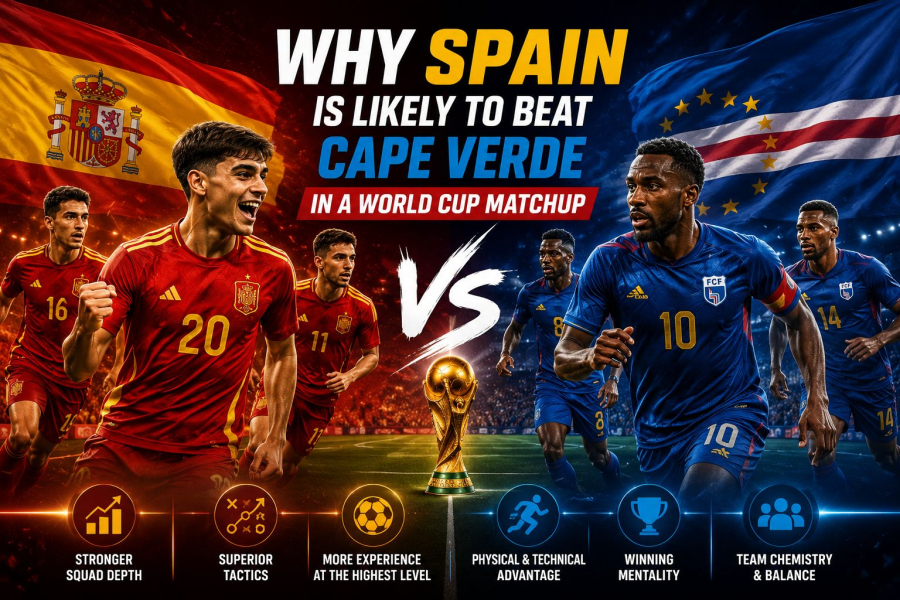
When you zoom out, Spain’s edge usually comes down to four pillars:
- Experience on the biggest stages (players and staff are accustomed to knockout-level pressure).
- Tactical clarity (structured build-up, positional discipline, and strong in-game management).
- Depth and role specialization (high-quality options beyond the starting lineup).
- Control of the game’s “temperature” (Spain typically excels at slowing chaos and forcing opponents into lower-percentage decisions).
Spain’s tournament pedigree: a practical advantage, not just a reputation
In any World Cup environment, pedigree matters because it translates into habits: how a team reacts after conceding, how it protects a lead, how it handles officiating swings, and how it navigates tight, late-game situations.
Spain’s international history is widely documented: Spain has won the FIFA Men’s World Cup (2010) and multiple UEFA European Championships, and Spain has also been a top-tier nation in international basketball, including multiple FIBA Basketball World Cup titles. You don’t need to know the exact lineup on the day to understand why this matters: national programs with long-standing high-performance infrastructure typically show up with better preparation and better crisis management.
Against a rising nation like Cape Verde, that often means Spain can:
- Stay composed if the underdog starts fast.
- Respond to momentum shifts without abandoning structure.
- Make more effective adjustments as the game reveals its true matchup dynamics.
Tactical structure: Spain tends to win the “decision-making” battle
World Cup matches are often decided less by highlight moments and more by repeated, correct decisions: when to press, when to drop, when to take risks, and when to keep the ball and reset.
Spain’s best teams historically have a clear identity built around possession, spacing, and disciplined positioning (in football) or ball movement, shot quality, and defensive rotations (in basketball). In both cases, the benefit is similar: Spain aims to produce a steady stream of high-percentage situations while limiting the opponent’s easiest routes to scoring.
Why that style is especially effective against an underdog
Underdogs often rely on a few key pathways to upset favorites:
- Transition chaos (quick counters or fast breaks).
- Set-piece or isolated efficiency (in football: dead balls; in basketball: a hot shooting night).
- Emotional momentum (crowd energy, early lead, frustration induced in the favorite).
Spain’s structured approach is designed to reduce those pathways. When Spain keeps the game organized and forces longer possessions (on either side), the matchup typically shifts toward the team with deeper technical quality and better repetition of patterns.
Depth: Spain can keep quality high for 90 minutes (or 40)
A huge reason favorites win at World Cups is not just the best starting players, but the drop-off (or lack of it) when substitutions and fatigue change the match.
Spain’s player pool is typically drawn from top-level professional environments, which tends to create:
- Reliable bench impact (players who can enter and maintain tempo).
- Multiple tactical looks (Spain can change shape, pressing intensity, or offensive emphasis).
- Strong game management late (fresh legs plus a clear plan).
Cape Verde, as a smaller nation, can absolutely field talented athletes and high-level professionals, but the depth challenge is real for emerging programs: one injury, one foul-trouble situation, or one fatigue dip can swing a tight game. Spain is often better positioned to absorb those swings.
Experience in high-pressure moments: Spain’s “calm advantage”
In World Cup matches, pressure creates mistakes: rushed passes, early shots, overcommitted presses, or undisciplined fouls. The team that remains calm often wins the final 15 minutes.
Spain’s competitive history typically shows an ability to:
- Protect a narrow lead with structured possession or disciplined defense.
- Find the next best option rather than forcing hero plays.
- Execute late-game routines (set plays, restarts, clock management).
That’s a major edge in matches where the underdog plays above expectations and the score stays close longer than predicted.
Key matchup themes that usually favor Spain
Without making assumptions about a specific squad list, you can still outline the matchup themes that tend to decide games between a tournament heavyweight like Spain and an ambitious challenger like Cape Verde.
1) Controlling tempo
Spain generally benefits from a controlled tempo. When the game is played on Spain’s terms, they can stack small advantages: better field position (football), better shot selection (basketball), and fewer “coin-flip” sequences.
2) Technical efficiency under pressure
Under World Cup pressure, teams often struggle to complete sequences cleanly. Spain’s technical base typically allows them to string actions together even when the opponent presses aggressively.
3) Defensive organization
Underdogs frequently need efficiency to beat favorites. Spain’s structured defending usually aims to reduce easy chances and force opponents into lower-probability attempts.
4) Tactical adjustments
World Cup games are rarely static. Spain’s staff and players tend to adjust well: changing pressing triggers, altering matchups, and using substitutions to target the opponent’s fatigue or spacing issues.
A quick comparison: what typically separates the teams in World Cup contexts
| Factor | Why it matters in a World Cup match | Typical edge |
|---|---|---|
| Tournament experience | Calm decision-making when the stakes spike | Spain |
| Depth | Maintaining intensity and quality after substitutions | Spain |
| Tactical structure | Reduces randomness; creates repeatable advantages | Spain |
| Transition threat | Underdogs often need quick, high-impact moments | Can favor Cape Verde if the game becomes chaotic |
| Composure in close finishes | Late-game execution often decides tight games | Spain |
The “Spain fan” case: what you can feel confident about
If you’re “for Spain,” there are a few practical reasons to feel optimistic, even while respecting Cape Verde’s ambition and potential.
Spain usually doesn’t need a perfect game to win
Elite teams can win even when parts of the match are messy. Spain’s structure often allows them to keep accumulating small edges until a breakthrough arrives.
Spain is built to handle surprises
Underdogs can surprise favorites with intensity, physicality, or a bold tactical plan. Spain’s tournament experience often helps them absorb that early wave and reassert control.
Spain can win in multiple ways
A major strength of top programs is versatility: they can win by dominating possession, by grinding a tight game, or by turning up the pressure late. That flexibility is extremely valuable in World Cup play.
How Spain can turn their advantages into a win (simple, realistic game plan)
Here’s a grounded outline of what a Spain-friendly path to victory usually looks like in a World Cup matchup against an underdog:
- Start composed: avoid conceding cheap transition chances early.
- Control the middle: dominate the central zones (football) or the half-court decision points (basketball).
- Force longer possessions for Cape Verde: make them execute multiple actions to score, not just one.
- Stay patient in attack: keep creating high-quality opportunities rather than rushing.
- Use substitutions to increase pressure: raise intensity when the opponent begins to tire.
- Manage the final phase: protect advantages with smart tempo, spacing, and discipline.
What Cape Verde would need for an upset (and why Spain can limit it)
Even as a Spain supporter, understanding the upset script helps clarify why Spain’s strengths matter. Upsets often require a combination of:
- An exceptional efficiency night (finishing, shooting, or conversion rate above normal).
- Winning the “chaos battle” (more transition chances, more second balls, more broken-play moments).
- Forcing frustration in the favorite (rushed decisions, loss of structure).
Spain’s ability to keep shape, slow the tempo, and rely on depth is exactly what tends to reduce those upset ingredients.
Success story mindset: why backing Spain is a smart, positive choice
Supporting Spain in a World Cup environment is often about more than just favoring the bigger name. It’s about trusting a model that repeatedly delivers:
- High standards in preparation and execution.
- Team-first clarity under pressure.
- Consistent competitiveness across tournament stages.
That consistency is the real “success story.” It’s not a guarantee in sports, but it is a meaningful advantage when you’re asking, “Who is more likely to win this kind of game?”
Conclusion: Spain should be favored, and the reasons are practical
In a World Cup-style matchup between Spain and Cape Verde, Spain is likely to win because their strengths align with what tournaments reward: experience, structure, depth, and composure. Cape Verde can absolutely bring energy, athleticism, and belief, but Spain’s ability to control tempo and make high-quality decisions over the full match is typically the difference-maker.
So if you’re for Spain, you’re backing a side that usually wins the way champions do: not only with talent, but with a repeatable system that holds up when the stakes are highest.
