When fans talk about “la Coupe du Monde,” they often mean football (soccer). But in this specific matchup, Spain and Cape Verde are most realistically compared in the context of the FIBA Basketball World Cup, where both nations have competed on the global stage.
This is a compelling contrast: Spain arrives with a long track record of elite international performance, while Cape Verde represents one of the most inspiring recent stories in global basketball—an ambitious, fast-improving program punching above its weight.
Below, we’ll break down the difference between the players from Spain and Cape Verde at the World Cup, then explain—factually and persuasively—why Spain is strongly positioned to win in a head-to-head matchup.
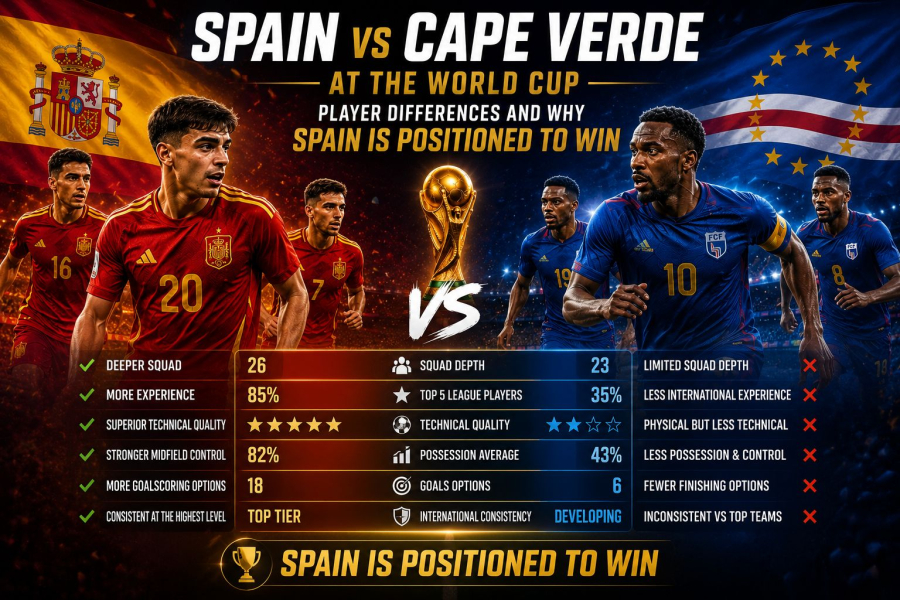
Quick context: Spain and Cape Verde at the FIBA Basketball World Cup
Before comparing players, it helps to set expectations based on World Cup history.
- Spain is one of the modern powerhouses of international basketball, with multiple deep World Cup runs and championship-level experience.
- Cape Verde is a rising basketball nation that has earned increasing respect, including breakthrough moments that reflect strong development and belief.
This isn’t just “big name vs small name.” It’s a matchup between two different stages of a basketball journey: established contender versus fast-growing challenger.
The core differences between Spain’s and Cape Verde’s players
On paper, the biggest gaps are not only about individual talent. They show up in depth, international experience, tactical versatility, and two-way consistency.
1) Depth and role clarity
Spain’s typical advantage: a deeper rotation with reliable contributors at multiple positions. Spain can often go 8 to 12 players deep without losing structure. That depth matters in a World Cup setting where games come quickly, foul trouble happens, and matchups change.
Cape Verde’s typical profile: more top-heavy. Cape Verde can feature high-impact players—most notably Walter “Edy” Tavares (a globally recognized center)—but the overall rotation generally has fewer players who can consistently create advantages against elite opponents for 40 minutes.
In practical terms, depth gives Spain more ways to win: they can survive cold shooting nights, adjust lineups, and maintain defensive intensity without exhausting key players.
2) International experience and “late-game calm”
At the World Cup level, late-game decision-making becomes a skill in itself.
- Spain tends to feature a core of players with repeated exposure to high-pressure international games, including medal rounds, elimination games, and tense finishes.
- Cape Verde has significantly less collective experience in those exact situations at the World Cup level, even if individual players compete in strong professional leagues.
That experience usually shows up in two places: shot quality late in games and defensive discipline when opponents run their best sets.
3) Style of play: system basketball vs matchup-driven attacks
Spain is famous for system basketball—structured offense, constant motion, and a heavy emphasis on making the “right” play. Their best teams often generate high-quality looks by moving the ball and forcing defenses to rotate.
Cape Verde’s strengths often lean more toward matchup advantages: using size at the rim, physicality, and the ability of key players to tilt possessions. With a player like Tavares, Cape Verde can control the paint on both ends when the game is played at his preferred tempo.
Both approaches can win games. But at the World Cup level, system-driven teams frequently deliver more consistent performance across different opponents because they don’t rely on a single player or a single type of advantage.
4) Defensive versatility and scouting execution
World Cup tournaments reward teams that can adjust quickly and execute a scouting plan.
Spain’s defensive identity typically includes:
- Strong communication
- Disciplined rotations
- Multiple coverage options in pick-and-roll
- Veteran understanding of time, score, and matchups
Cape Verde’s defensive ceiling can be very high—especially around the rim with elite size—but maintaining that level across every minute is harder if the rotation is thinner or if opponents can stretch the floor and force bigs away from the basket.
Side-by-side comparison table: Spain vs Cape Verde player profiles
| Category | Spain (Typical World Cup Profile) | Cape Verde (Typical World Cup Profile) |
|---|---|---|
| Team depth | Deeper rotation with defined roles across positions | More reliance on a smaller core of impact players |
| International experience | High: frequent tournament runs and pressure games | Growing: fewer collective World Cup high-pressure reps |
| Primary advantage | Structure, execution, versatility, and cohesion | Interior presence, athleticism, and standout star power |
| Offensive style | Ball movement, spacing, and read-based decisions | More matchup-driven; strong paint impact when available |
| Defensive style | Disciplined, adaptable schemes; strong team defense | Rim protection can be elite; consistency depends on matchups |
| “Plan B” options | Multiple lineup and tactical adjustments | Can be narrower if top options are limited by fouls or fatigue |
Why Spain is favored to win (and how that advantage usually shows up)
The editorial brief asks why Spain “will” win. In sports, guarantees aren’t factual. But it is factual to say Spain is typically favored due to structural advantages that tend to decide World Cup games.
Here are the most persuasive, reality-based reasons Spain is positioned to come out on top.
1) Spain’s advantage is bigger than individual talent: it’s a complete tournament toolkit
World Cups are not just about having a star. They’re about having answers:
- What if the threes aren’t falling?
- What if the opponent’s center dominates early?
- What if foul trouble hits?
- What if the game turns into a half-court grind?
Spain’s biggest advantage is that it usually brings multiple ways to win. That adaptability is a competitive superpower in a short tournament.
2) Coaching continuity and high-level tactical execution
Spain has been led by highly respected coaching at the international level, including Sergio Scariolo, who is widely known for tournament preparation, in-game adjustments, and getting lineups to perform above the sum of their parts.
This matters because in international basketball, opponents don’t have weeks to prepare. A team that can quickly diagnose what’s happening and adjust on the fly tends to control the most important minutes.
3) Ball movement travels: Spain’s offensive “floor” is higher
Shooting variance can swing a single game. But teams built on ball movement usually generate better shot quality over time.
Spain’s consistent strengths typically include:
- Creating open looks through passing, not just isolation
- Finding weak-side shooters after forcing rotations
- Making defenses work for 20 to 24 seconds
That’s why Spain can win even when it doesn’t look flashy. The offense doesn’t need to be spectacular; it needs to be efficient and repeatable.
4) Spain can game-plan for Cape Verde’s biggest weapon: interior dominance
Cape Verde’s most obvious advantage in many matchups is elite size and rim presence, highlighted by Tavares. A player of that caliber can:
- Change shots at the rim
- Control defensive rebounds
- Generate high-percentage looks close to the basket
Spain’s path to neutralizing that type of impact typically involves a blend of:
- Spacing to pull defenders away from the paint
- Quick decisions to avoid slow, predictable entries
- Attacking from angles (drives and cuts) instead of straight-line attempts
- Disciplined box-outs and physical rebounding by committee
Spain doesn’t need to “beat” Cape Verde at the rim on every play. It needs to reduce Cape Verde’s paint advantage while creating efficient offense elsewhere.
5) Guard play and late-game shot creation tend to decide tight World Cup games
In the final five minutes, World Cup games often slow down. That’s when:
- Free throws become critical
- Turnovers get punished
- One or two possessions can decide everything
Spain traditionally brings confident ball-handling and decision-making in those moments. Even when Spain is not the most athletic team, it often has the best mix of composure, spacing, and execution under pressure.
A positive spotlight on Cape Verde: why this matchup is more competitive than it looks
Even if Spain is favored, Cape Verde deserves real respect—and that’s good for the sport.
What Cape Verde does well (and why it matters)
- Paint control: With elite size, Cape Verde can change the geometry of the court.
- Energy and momentum: Underdog teams can ride runs, defensive stops, and confidence.
- Clear identity: When a team knows its strengths, it can play with freedom.
These are not minor traits. In a single game, they can create real problems—especially if Spain starts slowly or if Cape Verde’s role players hit timely shots.
What Spain needs to do to convert “favorite” status into a win
Being favored doesn’t win the game. Execution does. Spain’s best blueprint is straightforward and repeatable:
Keys to victory for Spain
- Win the turnover battle by valuing possessions and preventing transition chances.
- Control defensive rebounds to limit second-chance points.
- Keep the ball moving to shift Cape Verde’s rim protection and create open threes or cutting lanes.
- Make Cape Verde defend in space so the game isn’t played only at the rim.
- Stay patient if early shots don’t fall—Spain’s advantage grows over 40 minutes.
If Spain hits those marks, its depth and structure usually take over.
What Cape Verde needs for an upset (and why Spain will try to prevent it)
From a strategic perspective, Cape Verde’s upset recipe often includes:
- Dominating the paint on both ends
- Winning the rebounding margin
- Getting efficient scoring without needing long half-court possessions
- Staying out of foul trouble for key bigs and primary creators
Spain’s game plan will typically target exactly these points—because removing one or two pillars of that recipe forces Cape Verde to win in a less comfortable way.
The bottom line: the real difference—and the most convincing reason Spain is positioned to win
The difference between Spain’s and Cape Verde’s World Cup players is not simply that Spain has “better” players. The difference is that Spain tends to have:
- More playable depth
- More collective high-pressure experience
- More tactical flexibility
- A steadier, more repeatable style that holds up across matchups
That combination is exactly what wins World Cup games—and why Spain is strongly favored and realistically positioned to win this matchup over 40 minutes.
Cape Verde can absolutely make it competitive, especially through interior dominance and emotional momentum. But if Spain plays to its identity—connected defense, smart offense, and deep rotation—the most probable outcome is a Spain victory built on structure, composure, and execution.
FAQ
Is this comparison about football (soccer) or basketball?
This article focuses on the FIBA Basketball World Cup, where both Spain and Cape Verde have competed. The phrase “Coupe du Monde” can refer to football, but Cape Verde has not been a regular presence in the FIFA World Cup context.
Who is Cape Verde’s most recognizable basketball star?
Walter “Edy” Tavares is widely recognized internationally and is often viewed as the centerpiece of Cape Verde’s interior impact.
Why is Spain so consistently strong internationally?
Spain combines a strong basketball ecosystem, a proven national-team culture, and a style built on teamwork and tactical execution—traits that reliably translate to short international tournaments.
If you’d like, I can tailor this breakdown to a specific tournament year, group, or confirmed game matchup so the player comparisons reflect the exact rosters involved.
